
You are managing a hotel, a warehouse, a school campus or a construction site, and one question keeps coming back: should the team carry walkie talkies or just use their cell phones? On the surface both devices let you talk to another person. In daily use, they behave very differently.
This guide explains the difference between a walkie talkie and a cell phone in plain language. We compare how each works, how far each reaches, what each costs over time, how they hold up on a busy shift and where each one makes the most sense. By the end, you will know which tool fits your situation, or whether the smartest answer is to use both.
 Walkie Talkie vs Cell Phone: The Short Answer
If you only have a minute, here is the summary.
- Choose a walkie talkie when you need instant, one-to-many voice communication inside a defined area, no monthly bills, long battery life and equipment that survives drops, dust and rain.
- Choose a cell phone when you need to reach people anywhere there is network coverage, make private calls, send messages and photos, or use apps and the internet.
- Choose both when your team needs fast on-site coordination and also needs to reach customers, suppliers and head office.
The rest of this article explains why, with real-world detail you can use when making a buying decision.
What Is a Walkie Talkie?
A walkie talkie, also called a two way radio or handheld transceiver, is a portable radio that sends and receives voice over radio frequencies. It does not need a SIM card, a phone number or a mobile tower. Two or more radios tuned to the same channel or talkgroup can talk to each other directly.
Communication works on a push to talk (PTT) basis. You press a button, speak, release it, and everyone on your channel hears you at once. Because only one person transmits at a time (a method called half-duplex), conversations are short, clear and disciplined. That style is exactly why walkie talkies have remained standard equipment in security, logistics, manufacturing, hospitality and event management for decades.
Walkie talkies come in several families:
- Analog radios are simple, affordable and easy to use. If you are building a small team network, our range of analog walkie talkie models is a practical starting point.
- Digital radios (DMR) deliver clearer audio, better battery efficiency and extra features such as text messaging and GPS. Explore our DMR walkie talkie options for larger or more demanding operations.
- License-free radios operate in delicensed frequency bands, so small businesses can deploy them without going through a licensing process. See the license-free walkie talkie collection.
What Is a Cell Phone?
A cell phone, or mobile phone, is a multi-purpose device that connects to a cellular network run by a telecom operator. Your voice is converted to data, sent to a nearby tower, routed through the operator’s core network and delivered to the other person’s phone, often through several towers and data centres along the way.
Modern smartphones go far beyond calling. They handle messaging, email, maps, video calls, payments, cameras and thousands of apps. Calls are full-duplex, meaning both people can talk and hear at the same time, which suits natural one-to-one conversation.
That flexibility is a huge strength, but it comes with a dependency: no network, no call. The phone is only as good as the coverage, congestion level and balance on the plan behind it.
How Each Device Works: Direct Radio vs Cellular Network
The most important difference between a walkie talkie and a cell phone is the path your voice takes.
A walkie talkie transmits a radio signal straight from your device to the other radios. Nothing sits in the middle unless you add a repeater to extend coverage. A cell phone, in contrast, depends on a chain of infrastructure owned by a carrier: towers, backhaul links, switching centres and billing systems.
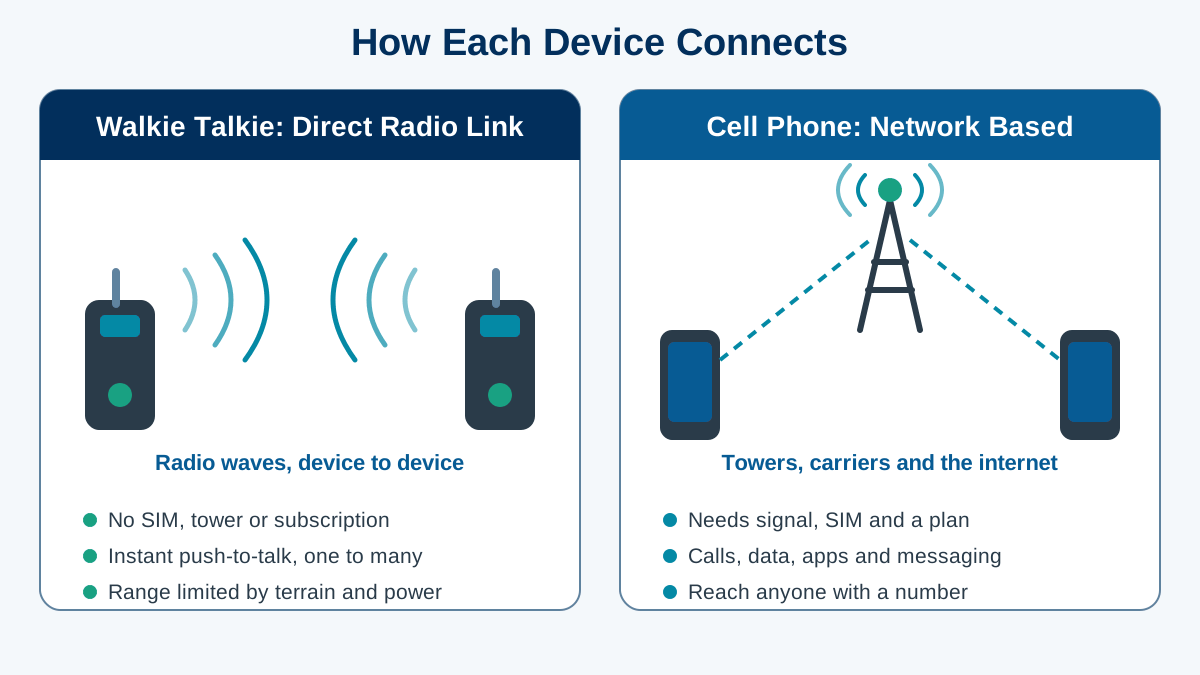
This single design choice explains almost every other difference in this article: why walkie talkies connect instantly, why they work when mobile networks fail, why phones can reach someone in another country and why one has monthly bills while the other usually does not.
Range and Coverage
Walkie talkie range depends on transmit power, antenna, frequency, terrain and obstacles. A compact handheld may cover a few hundred metres inside a concrete building or several kilometres in open ground. Higher-power radios paired with a repeater can cover an entire campus, a factory complex, a hill station or a city district.
Cell phone range is effectively as wide as the operator’s network. You can call someone across the country or across the world, as long as both of you have signal. The catch is that coverage is uneven. Basements, tunnels, mines, remote highways, mountain valleys and dense steel structures often have weak or no reception.
So the fair comparison is not “which goes farther?” but “which goes farther where my team actually works?” For a team spread across towns, the phone wins. For a team concentrated on one site, a properly configured radio system usually wins on reliability.
Reliability and Network Dependency
This is where walkie talkies earn their reputation. Because they do not rely on a carrier, they keep working during power cuts at towers, network congestion and natural disasters. When thousands of people try to use their phones at a stadium, a festival or after an emergency, mobile networks can slow down or drop calls. Radios on a private channel are unaffected.
That is why airports, ports, hospitals, hotels, fire services and event crews keep two way radios on hand even though everyone carries a smartphone. A communication tool that fails at the worst moment is not much of a tool.
Phones are generally very reliable in good coverage, and 4G and 5G networks have improved voice quality enormously. But reliability for a phone is shared with a third party. With a walkie talkie, you own the system.
Speed of Communication: Push to Talk vs Dialling
Think about what it takes to reach a colleague by phone: unlock the screen, find the contact, tap call, wait for ringing, hope they answer, then repeat the same process for the next person. If you need to alert five people, that is five calls or a group chat that someone has to notice.
With a walkie talkie, you press the button and speak. Everyone on the channel hears you within a fraction of a second. There is no ringing, no voicemail and no unanswered call. For a security guard reporting an incident, a supervisor redirecting a crew or a restaurant manager calling for backup, this speed is the entire point.
Group Communication
Walkie talkies are designed for one-to-many communication. A single transmission reaches an entire team, or a specific talkgroup in digital systems, such as housekeeping, maintenance or front desk. You can also set up an all-call for emergencies.
Cell phones can do group calls and messaging groups, but these tools are usually built on top of the phone rather than into it. Conference calls need to be arranged, group chats can be missed and everyone must have signal and data.
If your work needs constant, short coordination between many people, radios are simply the more natural fit.
Battery Life
A smartphone has a bright screen, apps running in the background, constant data use and often a battery that barely lasts a full day. Heavy use on a long shift means a power bank or a mid-day charge.
A walkie talkie spends most of its time in standby and has no large display or app load. A typical professional radio with a lithium-ion battery easily lasts a full 10 to 12 hour shift, and many digital models last longer thanks to efficient transmission. Spare batteries are cheap and swap in seconds, which means a radio can effectively run around the clock.
Durability and Build Quality
Smartphones are beautiful but delicate. Glass screens crack, water damages ports and dust can cause problems. A good case helps, but the device was designed to be a premium consumer product, not a tool for a loading dock.
Professional walkie talkies are designed for rough use. Many are built to military drop standards and carry dust and water ingress ratings such as IP54, IP67 or higher. Large rubberised buttons work with gloves, loud speakers cut through machinery noise and accessories like earpieces, remote speaker microphones and clip-on holders are designed for hands-free work. If your team works outdoors, in kitchens, on factory floors or around water, durability alone can justify the choice.
Cost: Upfront Price vs Running Cost
Cell phones can look cheaper at first because many people already own one. But a phone used for business has hidden costs: monthly plans for every employee, data charges, repair or replacement of cracked screens, insurance and the time lost to personal distractions.
Walkie talkies carry an upfront cost per radio, which varies by type, power and features, then have no airtime charges. Over several years, especially for teams of ten or more, this can make a radio network significantly cheaper per user. If you want to compare models, our professional walkie talkie range shows the options for different budgets, and you can ask for a quote to understand the price for your specific team size.
Security and Privacy
A walkie talkie conversation is shared by design. Everyone on the channel can hear it, which is a feature for team coordination but not ideal for sensitive discussions. Analog radios can be overheard by anyone with a compatible receiver on the same frequency. Digital radios improve this with built-in scrambling and optional encryption for organisations that need higher confidentiality.
Cell phone calls are private by default between two people, and modern networks encrypt traffic between the device and the tower. On the flip side, phones are exposed to app permissions, data tracking, phishing links and malware. They also carry personal information that raises questions in workplaces concerned about data protection.
Licensing and Regulation in India
Using a cell phone requires only a SIM from a licensed operator. Walkie talkies have a regulatory layer. In India, radio equipment generally operates either in delicensed bands, which can be used without an individual licence, or in licensed bands, which require approval from the Wireless Planning and Coordination (WPC) wing of the Department of Telecommunications.
Delicensed radios are popular with small businesses, schools and retail outlets because they remove the paperwork. Licensed systems, with higher power and wider coverage, suit large industrial sites and public safety organisations. Rules can change and equipment typically needs the correct type approval, so always confirm the current requirements before purchase. A knowledgeable supplier can guide you through this, and we are happy to help with it as a walkie talkie company in Delhi serving customers across the country.
Walkie Talkie vs Cell Phone: Comparison Chart
| Feature | Walkie Talkie | Cell Phone |
|---|---|---|
| Network needed | No | Yes, carrier network |
| Connection speed | Instant push to talk | Dial and wait |
| Best range | Local site or campus | Nationwide and global |
| Group talk | Built in | Needs calls or apps |
| Battery | Full shift or more | Often under a day |
| Durability | Rugged, weather rated | Fragile |
| Running cost | No airtime fees | Monthly plans |
| Extras | Limited, GPS and text on digital | Apps, internet, camera |
Where Each Device Works Best
Industries that benefit most from walkie talkies
- Hotels and resorts: front desk, housekeeping, engineering and security coordinate in seconds without disturbing guests with phone calls.
- Warehouses and logistics: forklift operators, loaders and supervisors stay connected across noisy, large floors.
- Construction and mining: rugged radios keep working in dust, rain and areas with poor mobile coverage.
- Schools and campuses: staff can reach security, medical rooms and transport teams quickly.
- Security services: guards need one-touch communication and an emergency call for the whole team.
- Events and venues: crowd density overwhelms mobile networks, but radios stay clear.
- Hospitals and manufacturing: fast, reliable coordination across departments and shifts.
Situations where a cell phone is the better choice
- Sales teams and field executives travelling between cities.
- Remote employees who need email, video meetings and messaging.
- Delivery staff who need maps, order apps and customer calls.
- Private one-to-one conversations with clients or management.
- Any task that needs a camera, document sharing or the internet.
Can a Cell Phone Replace a Walkie Talkie?
For casual use, a phone with a push-to-talk app can imitate a radio. Several apps and carrier services offer push to talk over cellular (PoC), which lets you press a button and speak to a group using mobile data. It is a useful option for teams spread over a wide area.
For demanding environments, though, a phone-based substitute inherits the weaknesses of the network: coverage gaps, congestion, data costs, battery drain and fragile hardware. Latency can also be longer than a true radio link. Many organisations therefore use a hybrid approach: radios for the on-site team and phones for staff who move beyond the site or need data.
How to Choose Between a Walkie Talkie and a Cell Phone
Ask yourself these five questions before you buy.
- Where does my team work? One building or site favours radios. Many locations favour phones.
- How fast must messages reach people? If seconds matter, choose push to talk.
- How many people need to hear each message? Large groups favour radios.
- What is the work environment? Dust, water, noise and long shifts favour rugged radios.
- What is my budget over three to five years? Include airtime, repairs and replacements, not just the purchase price.
If you are comparing brands, trusted names such as Motorola walkie talkie models are widely used across hospitality, industry and security because of their audio quality, accessories and long service life.
Frequently Asked Questions
Is a walkie talkie better than a cell phone?
Neither is better in every situation. A walkie talkie is better for instant group communication on a site, in areas with weak coverage or in tough conditions. A cell phone is better for long-distance calling, messaging and internet access.
Do walkie talkies need a SIM card or internet?
Traditional walkie talkies do not need either. They communicate directly using radio frequencies. Only PoC radios, which are a different category, use a SIM and mobile data.
What is the range of a walkie talkie compared to a phone?
Handheld radios typically cover a few hundred metres indoors to several kilometres outdoors, and repeaters extend this much further. A phone works anywhere with network coverage, including across countries, but fails where there is no signal.
Are walkie talkies cheaper than cell phones in the long run?
For teams, usually yes. Radios have no monthly airtime charges, last for years and cost less to replace if damaged. Business phone plans add up over time, particularly for larger groups.
Can walkie talkies work during a network outage?
Yes. Because they do not rely on mobile towers, radios continue to function during outages and heavy congestion, which is why emergency and safety teams depend on them.
Do I need a licence to use a walkie talkie in India?
Delicensed models can be used without an individual licence, while higher-power licensed systems need approval. Regulations can change, so confirm current rules or consult your supplier before buying.
Which is more secure, a walkie talkie or a cell phone?
Phone calls are private between two parties. Analog radio is open to anyone on the channel, but digital radios offer scrambling and encryption for added privacy.
Final Thoughts: Which Is Better for Your Business?
The honest answer is that it depends on how your team works. Phones connect you to the world. Walkie talkies connect you to your team, instantly, reliably and without a bill at the end of the month. If your staff work on one site, in groups, in tough conditions or in places with patchy coverage, walkie talkies are usually the better business investment. If they travel widely and need data, phones are the better fit. Many businesses use both, with each tool doing the job it does best.
If quick coordination, safety or large teams matter to your operation, a dedicated radio system is one of the most cost-effective upgrades you can make. Our team at The Global Electronics & Telecom Systems can help you choose the right type, power and accessories for your site and budget.
Ready to equip your team? Browse our professional walkie talkie collection, compare analog, DMR and license-free options, or contact our walkie-talkie dealer today for expert advice and a customised quote.

Leave a Reply